FIREFLIES, a new EU-funded Horizon Europe project, has officially launched to support biodiversity restoration and ecosystem resilience in European agricultural landscapes.
Across Europe, farming landscapes need to remain productive, adapt to climate change and recover the biodiversity that supports their long-term resilience. In many regions, larger fields, simplified crop systems, fewer semi-natural habitats and pressure on soil and water have reduced key ecological functions that help farms adapt, recover and remain resilient over time.
As the EU Nature Restoration Regulation moves into implementation, Member States are preparing national restoration plans and need practical evidence on how restoration measures can be implemented, supported and scaled in real farming landscapes. FIREFLIES will contribute to this challenge by working across five demo regions in Spain, Italy, Greece, Hungary and Lithuania, bringing together farmers, researchers, policymakers, advisors, companies and local stakeholders.
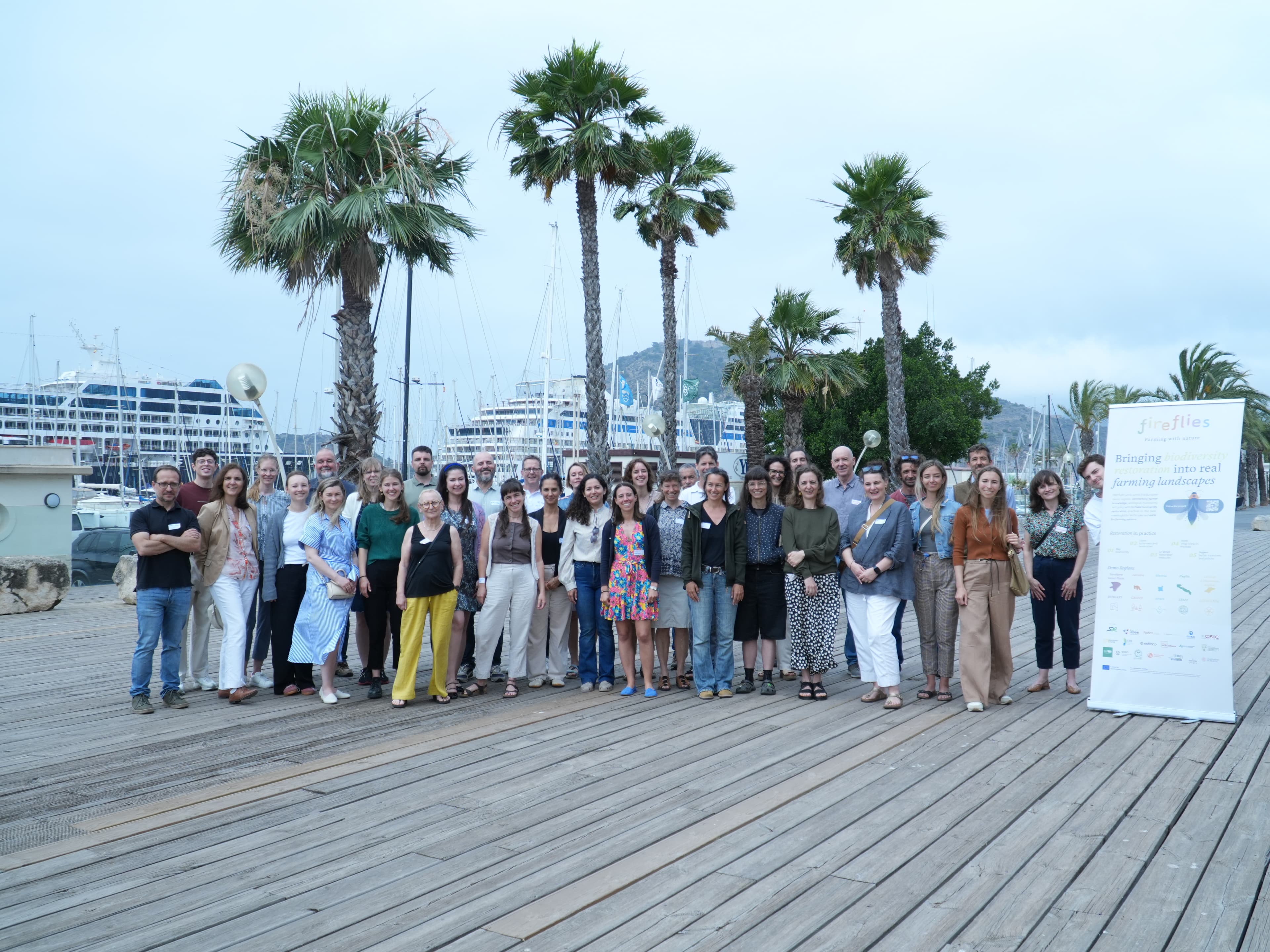
The project officially started with its Kick-off Meeting in Cartagena, where partners met to align the work ahead, discuss the policy context, map the realities of each demo region and begin shaping a shared approach for the next 36 months.
“Success for FIREFLIES will mean showing that changes at farm level are possible, feasible and useful. To achieve this, we need to enable conversations between farmers, scientists and policymakers, so that solutions are built around farmers’ needs and adapted to each local context,”
FIREFLIES Project Coordinator at SAE Innova
FIREFLIES will map farming systems and biodiversity baselines, work with farmers and local actors, co-design restoration measures, and assess their ecological, agronomic and economic effects in real conditions. The project will follow a participatory, farmer-centred approach to understand local needs and identify the kinds of support that can make biodiversity-friendly practices easier to adopt and sustain in the long term.
The five demo regions reflect different European agricultural realities: rain-fed almond systems in Murcia, Spain; monumental olive groves in Puglia, Italy; olive and citrus landscapes in Laconia, Greece; large-scale cereal systems in the Northern Great Plain, Hungary; and grassland restoration in the Middle Lithuanian Lowland, Lithuania.
Evidence generated by FIREFLIES will support science-based restoration targets, improved incentive schemes and policy recommendations for more resilient agricultural landscapes.